Another Sunday dawned and I was excited, for today we would visit one of my favourite places.
Cape Point.
Cape Point is a nature reserve within the Table Mountain National Park. The area of 7 750 hectares is rich in fauna and flora, abounding with buck, baboons and Cape Mountain Zebra as well as over 250 species of birds.
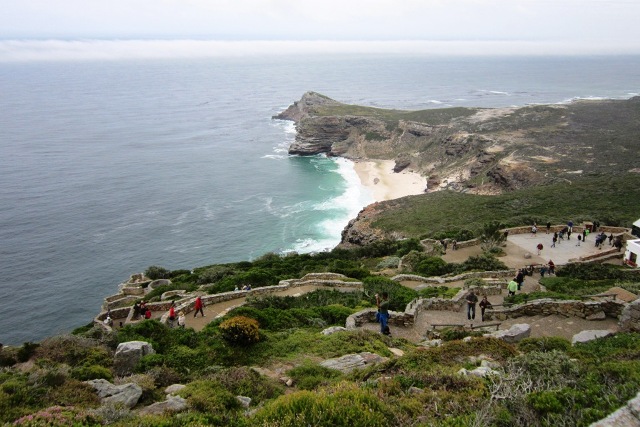
This spectacular finger of land is characterised by rugged rocks and sheer cliffs towering more than 200 metres above the sea. Standing at the lighthouse looking down onto the mighty ocean below always makes me appreciate the power of nature and the insignificance of my being.
This park falls under the protection of SanParks.
Entrance Fee: R80 for an Adult
Wildcard members enter for free!
There are various hiking trails to be taken in the park and the idea was to do one or more of the shorter trails, but unfortunately the weather was a bit dodgy and so we decided to stick to the very short paths. :)
Our first stop was a 20 minute trail with beautiful views of Smitswinkel Bay.
Reached only by foot, it is worth the effort to get there. The bay here is popular for snorkelling, diving and fishing and the water is calm and great for swimming.
I also managed to take a couple of pictures of my favourite subject...
Leucospermum cordifolium belongs to the protea family and is indigenous to South Africa.
From the middle of July to the end of November groups of Leucospermum cordifolium shrubs provide vivid splashed of orange and red. Many visitors from all over the world may recognise the flowers from flower arrangements they have seen in their own country. Nurseries in Israel, California, Hawaii, Zimbabwe, Australia and New Zealand produce large amount of cut flowers of hybrids and cultivars of this South African plant.
We also got to see some wildlife. :)
The scenic beauty of Cape Point is not its sole allure; it is also an international icon of great historical interest in many a visitor drawn to the area because of its rich maritime history.
In 1488 Bartolomeu Dias christened it Cape of Storms. The 'Point' was treated with respect by sailors for centuries. By day, it was a navigational landmark and by night, and in fog, it was a menace beset by violent storms and dangerous rocks that over the centuries littered shipwrecks around the coastline. (One of the very popular hiking trails in the area is also named 'The Shipwreck Trail'.
The route from the parking lot to the top lighthouse is beautifully layed out and offers spectacular views of Dias Beach.
If you do not feel like the steep uphill hike to the lighthouse you can always take the Flying Dutchman Funicular. It takes it name from the local legend of the 'Flying Dutchman' ghost ship.
As legend has it, the Flying Dutchman was captained by a Dutchman, Hendrik van der Decken, and was headed home from Jakarta to Holland in 1641. As Van der Decken approached the Cape, stormy weather shredded the ship's sails and waves flooded the deck.
The captain had rounded Cape Point on several occasions previously, but this time, a terrified crew implored him to turn back. He refused to submit to the elements and lashed himself to the wheel, swearing that he would sail around Cape Point, even if it took him until Doomsday.
An angel appeared on the deck and the enraged captain drew his pistol and shot her. Van der Decken's wish to round the point was granted that night, but he and his crew were doomed to sail these waters for ever more.
Over the past three-and-a-half centuries a ghostly sailing ship, that glows red in the night and has a mad, bald captain, has been sighted by a number of mariners. Those who have seen her say she lets down row-boats that approach with ghostly men aboard, desperately seeking a Good Samaritan to take their letters back home, where they haven't been for more than 300 years. But those who entertain these approaches are doomed...
We decided to take our feet to the lighthouse and had a lot of fun checking out all the little viewpoints along the way.
Standing on the highest section of the peak the original lighthouse stands 87 meters above its replacement. Now used as an outlook point and central monitoring point for all South African Lighthouses. This iron tower was built in 1857 and shone from its perch on Cape Maclear from 1860 until 1919 when it passed its candle onto the new lighthouse. The original lighthouse comprised of sixteen metallic reflectors which flashed a white light (2000 candle power) lasting twelve seconds every minute. In contrast the new Cape Point Lighthouse is the most powerful light on the South African coastline visible from a distance of thirty four nautical sea miles it emits a revolving light power of 10 000 000 Candelas.


The new lighthouse is closer to sea level, for two reasons: the old lighthouse could be seen 'too early' by ships rounding the point towards the east, causing them to approach too closely. Secondly, foggy conditions often prevail at the higher levels, making the older lighthouse invisible to shipping. On 18 April 1911, the Portuguese liner Lusitania was wrecked just south of Cape Point at on Bellows Rock for precisely this reason, prompting the relocation of the lighthouse.
There are so many more things to explore in this area and so much more stories to tell, but I will leave that for our next visit....